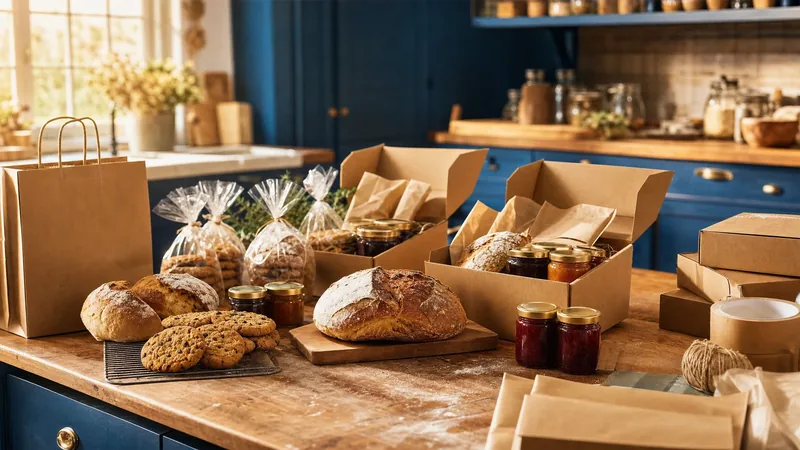
South Carolina Cottage Food Law: How to Sell Food From Home (No Cap, No Permit)
South Carolina Cottage Food Law: How to Sell Food From Home (No Cap, No Permit)
South Carolina lets many home bakers and food makers sell what they produce in their own kitchens with no sales cap and no state registration or permit under the home-based food production rules. The catch is that 'no permit' applies to that section of the law, not to everything else that comes with selling. You may still need a local business license, a sales tax registration, and a label written in a specific format.
This guide covers the process in the order most sellers find useful: confirm your product qualifies, set up the business side, write a compliant label, and sell through the channels the law allows. It also explains when you do need a permit and where the law is still unsettled.
This article is informational content, not legal or tax advice. Cottage food rules, local license requirements, and tax obligations depend on your products, your sales channels, and where you live. For complex situations, talk with a qualified attorney or a CPA before you start selling.
What South Carolina's Home-Based Food Production Law Allows
The core rule is S.C. Code Section 44-1-143, as amended by 2022 Act 208. Under that section, a home-based food production operation has no sales cap and needs no registration or permit to sell its products. The section sets limits on what you can make and where you can sell it:
- Allowed sales channels: direct sales to consumers, online sales, mail order sales, and sales to retail stores, including grocery stores. A store that sells your product must post a sign saying so.
- Allowed foods: non-potentially hazardous foods only. Examples include baked goods without cream fillings, candies, and breads.
- Excluded foods: potentially hazardous foods, which includes baked goods with cream fillings. Aluminum-canned goods and charcuterie are also excluded.
The section also exempts operations with under $1,500 in net earnings a year. Read that as a threshold that changes which rules apply to you, not as a free pass. Confirm with the South Carolina Department of Agriculture (SCDA) how the threshold works for your situation before you rely on it, and track your net earnings from the first sale so you know where you stand.
What You Need Before You Start
Gather these items before you file anything or print a label:
- One or more products you make the same way every time, with a written recipe
- A full ingredient list for each product, with amounts in weight (grams or ounces)
- A kitchen scale, since the label requires ingredients listed by weight and your records benefit from consistent measurements
- A product list with a yes or no column for each product against the allowed foods rules
- A business name and a decision on structure: sole proprietorship or LLC
- A computer and internet access for the Secretary of State and SCDOR online portals
- A simple sales and expense log, either a notebook or a spreadsheet
- Labels or packaging, plus a plan for your name and address, or your SCDA ID number if you use one
Step-by-Step: Selling Food From Home in South Carolina
Step 1: Confirm each product qualifies
Start with your product list. For each item, ask three questions. Is it a non-potentially hazardous food? Does it avoid cream fillings? Is it free of aluminum-canned packaging and not charcuterie? A cookie with a buttercream filling and a plain sugar cookie fall on different sides of this line, so check each recipe separately.
Products that do not qualify are not automatically illegal to sell. They fall outside the home-based rules and may need a retail food permit from SCDA. Pull those items from your launch list until you have that answer. Step 9 covers permits in more detail.
Step 2: Decide how you will sell and track your earnings
Choose your sales channels now, because they affect your labels, your records, and possibly your tax registration. A table at a local market, a website with shipping, and a grocery store placement each create different paperwork. Start with one or two channels. You can add more later, but you will need to update your records and check that each new channel still fits the rules.
Step 3: Pick a business structure and name
Many home sellers operate as sole proprietors. A sole proprietorship does not file organizing documents with the South Carolina Secretary of State at all. An LLC is a separate choice. Articles of Organization for a domestic LLC carry a $110 filing fee and can be filed through Business Entities Online at businessfilings.sc.gov. Online filings are returned within 24 to 48 business hours. The LLC name must include words such as 'limited liability company,' 'LLC,' or 'L.L.C.,' and the name must be distinguishable from other registered names.
South Carolina does not charge a recurring LLC annual report fee for a standard LLC. An LLC that elects to be taxed as a corporation has different filings, so confirm your tax treatment with a CPA.
If you sell under a name other than your legal name, understand that South Carolina has no state DBA filing. The Secretary of State does not register DBA or trade names. Instead, you show the trade name on your local business license, if your city or county requires one, and list it on your IRS EIN application and your SCDOR Business Tax Application. There is no separate county or municipal DBA filing.
Step 4: Check for a local business license
South Carolina has no general statewide business license. Registering with the Secretary of State does not count as a business license. Most cities levy business license taxes. Nine counties do as well: Beaufort, Charleston, Dorchester, Horry, Jasper, Marion, Orangeburg, Richland, and Sumter. The local license year runs May 1 to April 30, and renewals are due April 30. Renewals for participating localities are handled through localblrenewal.com.
Check with your city and county, since the application requirements and rates are set locally. If you live outside a city and outside one of those nine counties, you may have no local license to obtain, but confirm that with your county office before you assume it.
Step 5: Register for taxes with the SC Department of Revenue
The South Carolina Department of Revenue (SCDOR) handles sales tax. The state sales tax rate is 6 percent. Sellers of tangible goods must obtain a Retail License, which is a one-time, nonrefundable $50 fee per location. Baked goods and candy are tangible goods, so plan on this step. Apply through the Business Tax Application on MyDORWAY at dor.sc.gov. The retail license page is here.
Confirm with SCDOR how sales tax applies to each product and each sales channel, including online and mail order sales. If you form an LLC, plan to hire, or want a bank account in the business name, you may also need an EIN from the IRS.
Step 6: Write a compliant label
Every product needs a label with four items:
- Your name and address, or your SCDA ID number
- The product name
- Ingredients listed by weight
- This exact statement in all capital letters: PROCESSED AND PREPARED BY A HOME-BASED FOOD PRODUCTION OPERATION THAT IS NOT SUBJECT TO SOUTH CAROLINA'S FOOD SAFETY REGULATIONS.
Copy the statement word for word. Do not shorten it, reword it, or move it into a smaller font to fit a cramped label. Check whether any federal labeling rules apply to your products, such as allergen declarations, since they sit alongside the state requirements.
Step 7: Keep records from the first sale
Keep a log of every sale with the date, product, quantity, price, and sales channel. Keep receipts for ingredients and packaging. Record your net earnings for the year so you can check the $1,500 threshold from Step 2. Your tax preparer will need these records, and they also help you spot which products sell well.
Step 8: Sell only through the allowed channels
You can sell directly to customers at your home, at events, or by delivery. You can sell online and ship by mail order. You can sell to retail stores, including grocery stores, as long as the store posts the required sign. Before you approach a store, read the 'Where the Law Is Unsettled' section below, because the rules for store sales have an open question.
Step 9: Know when you need a permit
Food permits come from SCDA, not from the Department of Health and Environmental Control (DHEC). The state split those responsibilities in 2024, so if older articles or forms point you to DHEC for a retail food permit, confirm the current agency with SCDA.
If a product falls outside the home-based rules, you will likely need a retail food permit. SCDA exempts several low-risk foods from that permit, including boiled peanuts, snow cones, lemonade, and popcorn. Confirm the current list and conditions with SCDA before you sell any of them.
Where the Law Is Unsettled
There is a conflict you should know about. Older text in S.C. Code Section 46-57-20, added by 2023 Act 60, limits sales to direct sales and uses the phrase 'NOT FOR RESALE.' That text is still on the books, and it does not match the broader channels in Section 44-1-143. Until the conflict is resolved, sales follow SCDA's published guidance. If you plan to sell to grocery stores or other retailers, have an attorney review the question before you ship your first order to a store.
Tips for Staying on the Right Side of the Rules
- Start with a narrow product line. Two or three products are easier to label, test, and track than a full menu.
- Write the recipe in weights. Your label and any review of your product depend on accurate ingredient amounts.
- Print labels before you need them. A missing or wrong label is easier to fix before the first sale.
- Save your confirmations. Keep copies of your SOS filing confirmation, your local license, and your SCDOR retail license in one folder.
- Ask the store for its requirements. A grocery store may have its own rules for vendors, even when state law allows the sale.
Common Mistakes to Avoid
- Assuming 'no permit' means no paperwork. The home-based rules remove the state food permit, but local licenses and sales tax registration still apply in many cases.
- Paraphrasing the required statement. The all-caps sentence must appear exactly as written.
- Listing ingredients by volume or without amounts. The label requires ingredients by weight.
- Selling cream-filled or potentially hazardous items. These fall outside the home-based section, and selling them under it can create problems.
- Using a DBA without recording it anywhere. A name you use publicly but never list on your local license, EIN and SCDOR records can cause trouble when you open a bank account or apply for a license.
- Ignoring the $1,500 threshold. If you do not track net earnings, you cannot tell whether the threshold affects you.
- Relying on old articles. Agency names and rules change. Check current SCDA and SCDOR pages before you file.
What Results to Expect
Results vary with your product, your location, your pricing, and how much time you put into sales. Many home sellers start with a small set of products sold to neighbors, friends, and local customers. Some expand into online orders or a store placement after a few months of steady sales. Others keep the business small on purpose. Plan on a slow first few months while you learn your costs and build a customer base, and do not assume any particular income from the start.
When you describe your products, keep your claims to flavor, ingredients, and the experience of eating them. Avoid health, disease, or cure claims. FDA can treat a food as an unapproved drug when its labeling or marketing makes disease claims, and a claim your label cannot support can damage your reputation even if no agency acts on it.
Questions to Confirm With Each Agency
- SCDA: how the $1,500 net earnings threshold applies to you, which products qualify, whether store sales are allowed under current guidance, and which low-risk foods are exempt from a retail food permit.
- SCDOR: whether your retail license applies to each product and channel, and how sales tax applies to online and mail order sales.
- Your city or county: whether a local business license applies, what it costs, and how and when it renews.
- Your attorney or CPA: how to structure the business, how to handle the statutory conflict, and how to report your income.
Cottage food rules are a good starting point for a small food business in South Carolina, but they are not a complete checklist. Confirm each step with the agency that governs it before you sell. This article is informational content, not legal or tax advice.
Keep exploring: related South Carolina guides
- How to Start a Coffee Shop Business in South Carolina
- How to Start a Food Manufacturing Business in South Carolina
- How to Start a Catering Business in South Carolina
- How to Start a Food Truck in South Carolina
- How to Get a Liquor License in South Carolina
- How to Start an LLC in South Carolina
- South Carolina Business License
- How Much Does It Cost to Start a Business in South Carolina
- All South Carolina business types
- Every South Carolina guide in one place